Planning the Demolition of an Old House, Barn, or Outbuilding
The best demolition jobs are decided before the first wall comes down.
October 27, 2026 · 4 min read
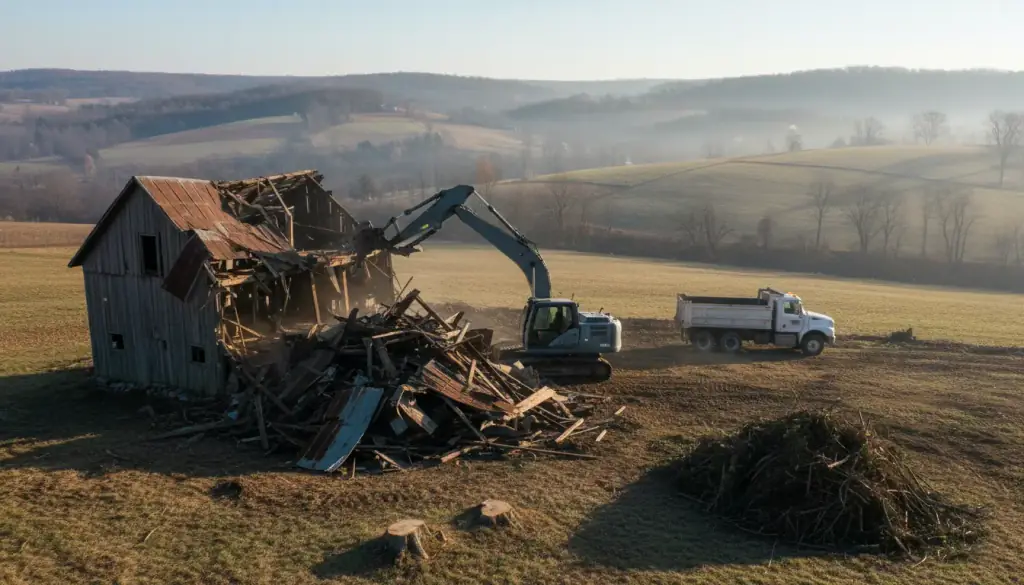
Taking down an old house, a barn, or a leaning outbuilding looks simple from the road: a machine arrives, the building comes down, a truck leaves. The reality has more steps, and most of the good decisions happen before anything gets touched. We handle demolition for homeowners, contractors, and developers, and the jobs that go smoothly are almost always the ones that were planned well. This article walks through what that planning involves, what happens to all the material, and how the lot gets left when we are finished.
Start with what is there
Every structure has its own history. A farmhouse that was added onto three times behaves differently from a block outbuilding. A barn with a failing roof is a different job from a garage in decent shape. During a site visit we look at what the building is made of, how it is attached to anything else, where it sits on the lot, and what is around it: fences, trees, driveways, neighboring structures, and overhead lines. We also ask what you want afterward. A lot that will be built on needs a different finish than a lot that will be seeded and left open.
Utilities and what is under the building
Before a wall comes down, the services that feed the building have to be dealt with. Electric, water, gas, and sewer or septic connections should be shut off and disconnected properly, which is usually coordinated with the utility or the service provider. Old properties also hide things: cisterns, wells, buried tanks, abandoned drain lines, and basements or crawlspaces full of whatever got dropped in over the years. A hole that was never filled is a hazard waiting for a mower or a child. Finding and handling these is part of the job, and it is one reason we want to walk the site before we give you a number. Some older materials also need special handling, and it is worth raising that early so it can be sorted out before work begins.
What a demolition plan covers
- Which structures come down and which stay
- How utilities are shut off and capped
- Where machines will enter and where materials will be staged
- How trees, fences, and neighboring property are protected
- Where the debris goes and how it gets there
- What the lot looks like when we leave
Every job has a project manager, and no work starts without that person's go-ahead. By the time the machine fires up, the plan has already been talked through with you, so there are few surprises on the day.
Where the debris goes
Demolition produces a lot of material, and it has to go somewhere. We tear down the structure and haul the materials to a local dumpsite. On larger jobs the trucks run in a steady loop, so debris is moved out as the building comes down instead of piling up beyond what the site can handle. Material can also be moved between sites when that makes sense, which keeps a project from being held up by a heap of rubble in the yard. It is worth asking any contractor where your debris is going. The answer tells you whether the job is being finished or just moved out of sight.
Sorting happens as the building comes down. Wood, masonry, metal, and roofing do not all behave the same way, and keeping them apart keeps the loads manageable and the lot workable. Trying to dig through a mixed pile after the fact is slower and messier than separating as you go.
Clearing the lot afterward
A demolition is not done when the walls are down. The foundation or slab has to be dealt with, basements filled, and the ground shaped so water drains and nobody walks into a hole. Then comes the rest of the clearing: leftover stumps, brush, broken concrete, and buried debris. Because we are an excavating company, one outfit can take the building down, clear the lot, and grade and prep the site, so there is no handoff between a demolition crew and an excavation crew and no gap where responsibility gets fuzzy.
For a new build, we can grade the site and prep it for the next trade. For a lot that will sit for a while, we can leave it smooth, shaped to drain, and ready to be seeded. Either way the goal is a finished piece of ground, not a pile.
We take down houses, barns, sheds, and commercial structures. The scale changes. The approach does not: look closely, plan the sequence, move material out as it comes down, and leave the lot in a state you can use. If you are not sure what your building will involve, a free on-site consultation is the quickest way to find out.
To talk about taking down a structure on your property, call (717) 385-1863 for a free estimate.
Elwood B. Shughart & Sons Excavating, (717) 385-1863
Call (717) 385-1863More articles
What Happens to a Lot Before the Foundation Goes In
Site prep is the part of a build most owners never see, and it decides how the rest of the project behaves.
Why Septic Siting Starts With the Ground, Not the House
The tank is the easy part; choosing the right spot on your land is the real work.