What Happens to a Lot Before the Foundation Goes In
Site prep is the part of a build most owners never see, and it decides how the rest of the project behaves.
October 27, 2026 · 4 min read
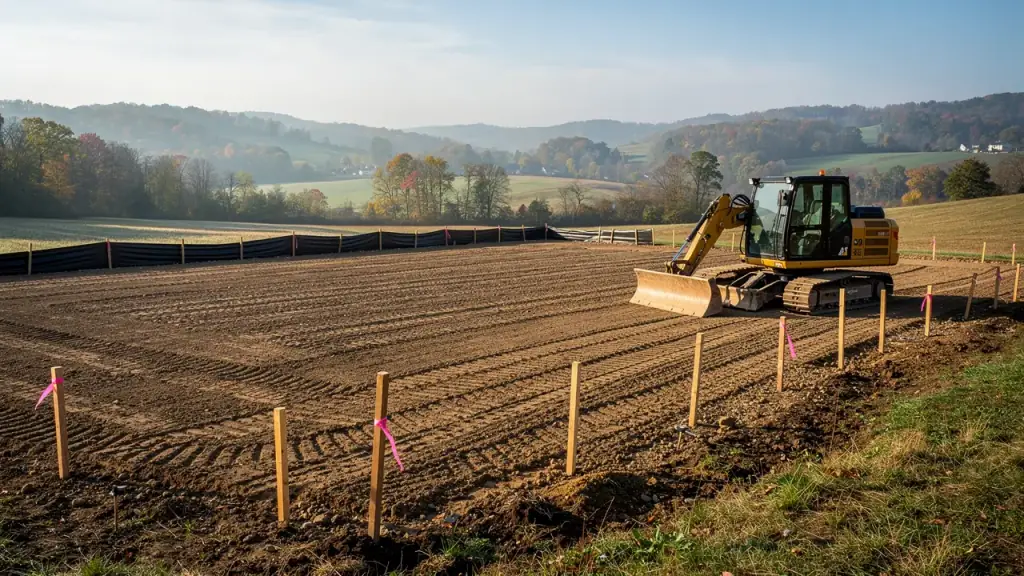
A building lot rarely arrives ready. There are trees, brush, stumps, old fence lines, uneven ground, and soil that has been soaking up rain for decades. Before a foundation crew or a framer can do anything useful, somebody has to turn that raw ground into a clean, stable, properly shaped site. That is what site prep is, and it is the part of a project most owners never see once the house is standing. We are a family-owned excavating company in Carlisle, PA, and we have been doing this work since 1970. Here is what site prep involves, why each step exists, and what you should expect when you hire it out.
Clearing and grubbing
Clearing means taking down trees and brush and getting them off the lot. Grubbing is the less visible half: pulling out stumps and the root mass underneath them. Roots left in the ground rot over time, and rotting roots leave voids and soft spots. A slab or footing sitting on top of that can settle unevenly. So we dig roots out instead of cutting everything off at ground level. How much of the lot gets cleared is a conversation, not an assumption. Some owners want every tree gone. Others want a stand of mature trees kept near the road or along a property line, and then the house, the drive, and the utilities have to be laid out around them.
- Trees, brush, and fallen timber removed or set aside as agreed
- Stumps and root masses pulled out, not just cut flush
- Old fencing, debris, and anything abandoned or buried found and dealt with
- Trees you want to keep marked before the machines start moving
Topsoil is stripped and saved
Topsoil is the dark, organic layer at the surface. It is wonderful for growing a lawn and poor for holding up a building, because it compresses and breaks down. So it gets scraped off the building area and set aside, and the firmer material underneath becomes the working surface. Done right, that topsoil is stockpiled to one side and spread back over the finished yard once construction wraps up. It is your lawn, and you already own it. There is no reason to haul it away and buy it back later. If the lot has more topsoil than the finished grade needs, the extra can be moved to another part of the property or taken to another site.
Erosion control comes before the rain
Bare ground and rain do not get along. Once the vegetation is gone, a hard storm can wash loose soil downhill into a neighbor's yard, a road ditch, or a stream. Erosion control is the set of measures that keeps the dirt on the lot. It usually means silt fence along the low edges, a stabilized place for trucks to enter and leave, and grading that sends water where you want it to go instead of where it finds its own way. It goes in early, ideally before heavy equipment starts disturbing the ground, because the first storm after clearing is the one that tests it. It protects your own project too. A site that washes out has to be re-graded, and nobody enjoys paying for the same work twice.
Grading to sub-grade
Sub-grade is the shaped, compacted surface that sits just below the finished floor, driveway, or pad. Grading to sub-grade means bringing the ground to the right elevation and the right slope for whatever is going on top of it. Finish-grading comes at the end and puts the final surface in place. Between those two stages the foundation, the utilities, and the structure go in.
Getting sub-grade right matters for a simple reason: water. Ground around a building should fall away from it, so rain moves off the lot instead of toward the walls. A few inches of difference in the wrong direction turns into a wet basement or a heaved slab years later. Grade stakes mark the target elevations so the operator cuts and fills to a plan instead of by eye. Where the plan calls for fill, it goes in and gets compacted, because loose fill settles and compacted fill holds.
What to expect from us
Excavation is not just digging holes. It starts with a conversation and a walk around the property. After a consultation, we can assess the kind of preparation your land needs, and the consultation and the estimate are both free. We work on commercial and residential sites, and the steps above apply to both. Nothing begins until the project manager gives the go-ahead, so you are never surprised by a machine showing up before the plan is settled.
If you are comparing contractors for site prep, these questions will tell you a lot about who has thought the job through:
- What gets cleared, and what stays?
- Where does the topsoil go, and does it come back?
- What is protecting the low side of the lot when it rains?
- What elevation is the sub-grade, and who checked it?
If you have a lot you want ready for building, call us at (717) 385-1863 for a free estimate. We will walk the property with you and tell you what it needs.
Elwood B. Shughart & Sons Excavating, (717) 385-1863
Call (717) 385-1863More articles
Why Septic Siting Starts With the Ground, Not the House
The tank is the easy part; choosing the right spot on your land is the real work.
Planning the Demolition of an Old House, Barn, or Outbuilding
The best demolition jobs are decided before the first wall comes down.