Sinkholes in Limestone Country: How They Show Up and How They Get Fixed
A sinkhole is the end of a process that started underground, and fixing it means finding the edge of the problem.
October 27, 2026 · 4 min read
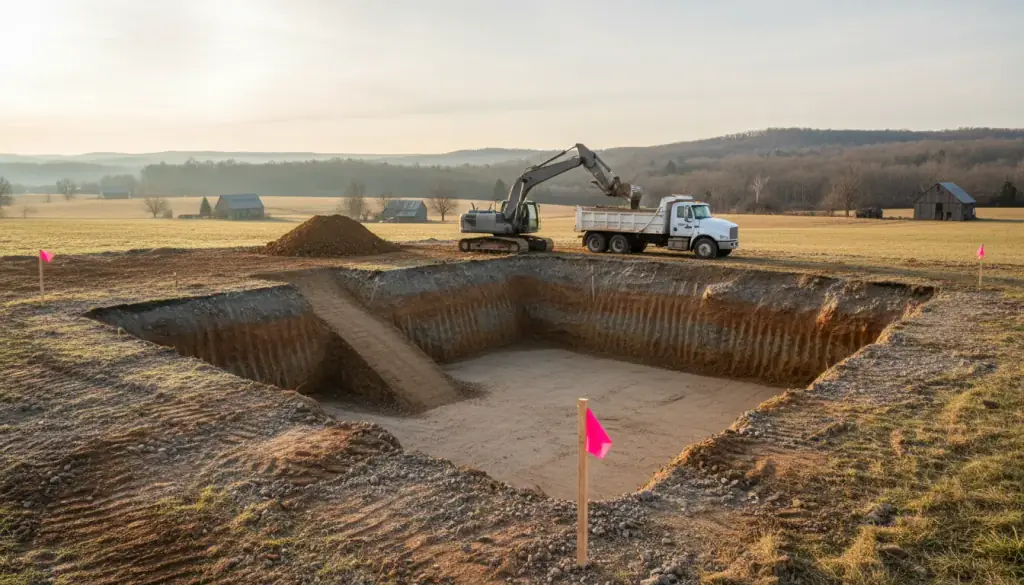
The Cumberland Valley is good farm and residential country, and under much of it sits limestone. Limestone is a rock that water slowly dissolves. Over a very long time that creates channels, pockets, and voids below the surface, and the soil above can settle or drop into them. The result is a sinkhole, and some property owners around Carlisle find one, or something that looks like one, at some point. Sinkhole repair is part of our excavation work. Here is what they look like, what to do when you spot one, and how the repair actually works.
How a sinkhole shows up
Not every sinkhole is dramatic. Some open overnight as a hole with straight sides. Many arrive slowly: a soft spot in the lawn that keeps sinking, a depression that collects water after rain, a crack in a driveway or foundation wall, or a patch of ground that drops a little more every season. Sometimes a leaking pipe or a downspout outlet washes soil away underneath until the surface finally gives. Here are the signs worth a phone call:
- A round or oval depression that is new or getting deeper
- Ground that sinks under a mower or a footstep
- Water that drains into one spot and disappears
- Fresh cracks in a slab, driveway, or foundation near a low spot
- A hole with exposed soil walls, even a small one
What to do first
Keep people, children, pets, and livestock away from it. Do not fill it with whatever is handy, like brush, stone, or old concrete. Material dumped in a hole can hide the problem for a season and then drop with the soil around it. Stay off the edge with vehicles and equipment, since the ground beside an opening is often weaker than it looks. Take a photo, note when you noticed it, and call someone who does this work. If the opening is near a building, a road, or a utility line, call sooner, and if you suspect a broken line, contact the utility as well.
How the repair works
Every sinkhole is a little different, but the craft follows the same logic: find where the ground is sound, remove what is not, and rebuild it in a way that will hold. In general the work goes in four steps.
- Assess: we look at the size and shape of the opening, what is around it, where water is coming from, and what nearby could be affected.
- Excavate to sound material: the loose, disturbed, and washed-in soil is dug out until we reach ground that is firm and undisturbed. That can be deeper than the surface hole suggests.
- Backfill and compact: clean material goes back in layers, and each layer is compacted before the next, so the fill is tight and does not settle like loose dumped soil.
- Restore grade: the surface is shaped so water drains away and no longer funnels into the same spot, then topsoil goes back for seed.
Some situations call for more than a standard repair, such as a very large opening or one right next to a structure. In those cases we will say so, and an engineer may need to be involved. We will not pretend that digging and filling solves everything. What we can tell you is that a good repair starts with an honest look at the hole.
Why this is excavation work
People sometimes expect a sinkhole fix to be a matter of dumping fill into the opening. It is not, because the visible hole is only the end of a process. The ground below the opening has been disturbed, and until you excavate you do not know how far that goes. Digging it out is how you find the edge of the problem. That is why the repair belongs with an excavating contractor that has the equipment to dig safely, handle the material, and compact it properly. Excavation is not just digging holes. It is knowing what you are looking at when you reach the bottom.
Fix the water, too
Many sinkholes trace back to water going where it should not: a leaking pipe, a downspout dumped at one spot, or a low area where runoff gathers. Fixing the hole without fixing the water invites the next one. So part of our work is looking at roof drains, storm sewer lines, and surface grading nearby, because we install those too. If a drainage change would help keep the repair from being undone, we will tell you what we see and what we would do.
We work on commercial and residential properties, and sinkhole repair is on our list of services alongside site demolition, rock excavation, and grading. If something has opened up on your land, or you are not sure whether what you are seeing is a sinkhole at all, call (717) 385-1863 for a free estimate and an on-site look.
Elwood B. Shughart & Sons Excavating, (717) 385-1863
Call (717) 385-1863More articles
What Happens to a Lot Before the Foundation Goes In
Site prep is the part of a build most owners never see, and it decides how the rest of the project behaves.
Why Septic Siting Starts With the Ground, Not the House
The tank is the easy part; choosing the right spot on your land is the real work.